Every fall drink I have been handed since Labor Day has tasted like a candle. Sweet, thick, vaguely of pie, and by the third one I want a glass of water and a lie down.
This is the other kind. Cold, sharp, and about as far from a whipped cream situation as you can get while still tasting like October. Five minutes of real work. The syrup keeps three weeks in the refrigerator, and it goes hot or cold depending on what the weather is doing that day.
I make it without alcohol most nights and with rye when there is company.


What you need
Syrup, makes about 1 1/4 cups, enough for eight drinks
-
1/2 cup sorghum syrup (a Southern cane syrup, not molasses, see below)
-
1/2 cup water
-
1/3 cup apple cider vinegar
-
2 tablespoons fresh ginger, coarsely grated, skin and all
-
1 cinnamon stick, broken in half
-
4 whole allspice berries, cracked with the flat of a knife
-
2 wide strips of orange peel, no white pith
-
A pinch of salt
One drink, cold
-
3 tablespoons syrup
-
4 ounces unfiltered apple cider
-
2 ounces sparkling water
-
Ice, and a thin slice of apple if you are feeling formal
One drink, hot
-
3 tablespoons syrup
-
6 ounces cider, hot but not boiling
-
A strip of lemon peel, twisted over the mug before it goes in
How to make it
Warm the sorghum and water in a small pan over low heat until the sorghum loosens and stirs easily. About two minutes. Do not let it boil.
Take the pan off the heat. Add the ginger, cinnamon, allspice, orange peel and salt, then leave it alone for twenty minutes while it steeps.
Stir in the cider vinegar last, once the pan has come off the heat and started to cool. This is the step that matters. Heat dulls the vinegar and dulling the vinegar removes the entire point of the drink.
Strain into a jar. It is drinkable right away and better tomorrow.
Cold build: syrup in the glass first, then cider, then sparkling water, then ice. Stir once. Hot build: syrup in the mug, hot cider poured over it, lemon peel twisted and dropped in.
With rye, use 2 ounces and cut the sparkling water to 1 ounce. Bourbon works and comes out rounder. Rye is better, because the spice in the syrup wants something dry to argue with.
About the vinegar
Yes, there is cider vinegar in it. No, it does not taste like vinegar.
It is doing the job lemon does in lemonade. Leave it out and you have sweet spiced cider, which is fine, and which everybody already has. Put it in and the drink turns crisp and keeps moving instead of settling on your tongue. If you have ever squeezed a lemon into iced tea and been surprised how much better it got, this is that, wearing a coat.


Getting the balance right
Taste the syrup before you build anything, and adjust the syrup rather than the finished drink.
-
Too sharp for you: add sorghum a teaspoon at a time. Do not add water, which flattens it rather than sweetening it.
-
Too flat or too sweet: add vinegar a teaspoon at a time, then wait five minutes before you judge it. It keeps developing in the jar.
-
Thin and watery: your cider is filtered. Unfiltered has the body this needs.
-
Harsh instead of bright: the vinegar went in while the pan was hot. Off the heat next time.
About the sorghum
Sorghum is the ingredient most likely to stop you, so let me explain it before you decide you do not have any.
Sorghum syrup comes from a tall grass called sweet sorghum. The stalks get cut and stripped, the green juice gets pressed out, and then it is boiled down until it thickens, the same way maple sap becomes maple syrup . That is the entire process. One ingredient, cooked down.
It is not molasses, though half the jars in the South say sorghum molasses on the label and the two words get used interchangeably across Tennessee, Kentucky and the Carolinas . Molasses is what remains after sugar cane is refined into sugar, so it is a byproduct . Sorghum is the whole juice, boiled straight, which is why it tastes cleaner and less bitter.
Side by side, sorghum runs thinner than molasses and noticeably tangier . The description I have read that lands closest calls it buttery, and quotes a mother saying it has a whang to it, which is about right . Sweet first, then sharp, then the faintest bitterness underneath. That built in sourness is exactly why it belongs in this drink. It is already leaning the direction I want to go.
It is also a fall product. Syrup making runs from the middle of September to the end of October , which puts it in season at the precise moment you would want to drink this.
Where to find it: look for the word sorghum on the label rather than the word molasses, since sorghum is always displayed prominently when that is what is in the jar . Southern grocery stores stock it, country stores and roadside stands have it in the fall, and it ships year round. A jar lasts, because half a cup makes eight drinks.
If you cannot get it, sorghum swaps one for one with molasses, honey or maple in most recipes . In this drink, molasses goes darker and more bitter, maple is the crowd pleaser and the least interesting version, and honey fights the ginger. Any of them makes a good drink. Sorghum makes this one.
One last thing, since so many of the cards in my box came out of farming country. Sorghum was cheap, tough in bad weather, and something a family could grow and boil at a neighbor's mill, which made it the sweetener of choice in Appalachia when granulated sugar was out of reach . It has mostly gone now. American production ran past twenty four million gallons by 1890 and sits near a single million today . Buying a jar is a small act of keeping something alive, which is more or less the point of this whole website.

Where the drink comes from
Here is the part I like.
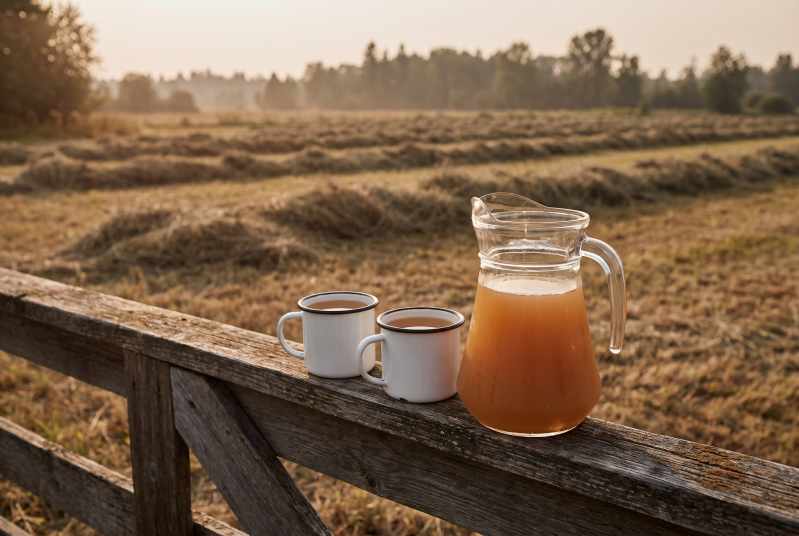
This is a switchel. Sweetener, vinegar, water and ginger, mixed cold and drunk the same day. Hay crews carried it into the fields through the American summer, which is why it also went by haymaker's punch, and the traditional pairing was cider vinegar with molasses, both of them homegrown North American products.
It sits in the same family as a shrub, which came out of 17th century England and stayed popular through the colonial period as a way to get fruit, sweetness and sharpness into one glass. The difference is patience. A proper shrub steeps fruit in vinegar and sugar for a week or more. A switchel is what you make when there is work waiting.
Which means this drink was built for people who were hot, tired and busy. More or less the emotional condition of anyone hosting in the fall.

Sources
A note on how I use these: the sorghum facts, the switchel history and the shrub history come from the sources below. Where I say something is my read, my taste or my call, it is mine and carries no source.
-
Grub Americana, Sorghum Syrup: Sweet Elixir of the South, 2012. How the syrup is made, the September to October season, the production figures, and cup for cup substitution. Food history blog.
-
Southern Living, What Is The Difference Between Sorghum And Molasses?, 2023.
-
Food and Wine, The Difference Between Sorghum and Molasses, 2022. Consistency and tang.
-
Our State, Tastes Like Home: Sorghum Syrup, 2016. Where the buttery description and the whang come from.
-
The Dutch Treat, Molasses or Sorghum Molasses, 2019. On labeling. Retailer blog.
-
A Sweet Appalachian Tradition: Sorghum Syrup, 2024. Blog.
-
The Laurel of Asheville, Sorghum, the Sweetest Appalachian Tradition, Dries Up, 2024.
-
Royal Coffee, Shrubs and Switchels: North American Heritage, 2018. Switchel as haymaker's punch, and switchels as instant shrubs.
-
Revolutionary Pie, Fruit Shrubs, 2013. Shrub origins in 17th century England, and the week long steep. Blog.
.