
Most turkey rub recipes have the same flaw. They dump the salt in with the herbs, hand you one fixed quantity, and leave you guessing whether that amount is right for the bird sitting in your refrigerator. A 10-pound turkey and a 22-pound turkey are not the same problem, and salt is the one ingredient where guessing has consequences.
So this is two bowls, not one. A salt mixture scaled to the weight of the bird, and a saltless herb rub that you can make in any quantity and keep for the rest of the winter. Mixing them together is what forces the compromise. Keeping them separate is what makes the blend work on a 12-pound breast and a 20-pound whole bird without recalculating anything.
The other reason to separate them is that the salt has a job to do days before the herbs matter at all.
Bowl one: the salt
This is a dry brine. It goes on 24 to 72 hours ahead, and it does the actual work of seasoning the meat rather than the surface.
Per pound of turkey:
-
4 grams kosher salt, which is roughly 1 1/2 teaspoons Diamond Crystal or 3/4 teaspoon Morton
-
1/4 teaspoon baking powder
For a 14-pound bird that works out to about 56 grams of salt, which is 6 to 7 tablespoons of Diamond Crystal or about 4 tablespoons of Morton, plus 1 tablespoon of baking powder.
Weigh the salt if you can. Kosher salt brands differ enough by volume that a cup of one is meaningfully saltier than a cup of another, and this is the one place in the recipe where that matters.
The baking powder is not a typo. It raises the pH of the skin, which helps it brown and crisp instead of turning to leather.


Bowl two: the herb rub
This makes about 1/3 cup, enough for a 14-pound bird with a little left over. No salt in it, so scale it however you like.
-
1 tablespoon dried sage
-
1 tablespoon dried thyme
-
2 teaspoons dried rosemary, crumbled fine
-
1 tablespoon garlic powder
-
2 teaspoons onion powder
-
2 teaspoons coarse black pepper
-
1 teaspoon smoked paprika
-
1 teaspoon ground fennel
Crumble the rosemary between your fingers before it goes in. Whole dried rosemary needles do not soften in an oven and they are unpleasant to bite into.
The fennel is the ingredient nobody expects and the one that makes the blend taste deliberate rather than generic. It reads faintly sweet and anise-like against the sage, and it is the reason this tastes like a rub someone designed instead of the contents of a poultry seasoning jar.
The smoked paprika is there for color as much as flavor. A dry-brined bird browns beautifully on its own, but a small amount of paprika gives the skin a deeper mahogany.
Why there is no sugar in it
Nearly every turkey rub you will find includes brown sugar. It is not a mistake exactly, but it is a tradeoff that most recipes do not mention.
Sugar helps skin brown, which is why it shows up. The problem is duration. A turkey is in the oven for two to four hours, far longer than a chicken or a pork chop, and sugar that sits on the surface that long scorches at the thin edges. Wing tips and the tops of the drumsticks go bitter before the thigh reaches temperature.
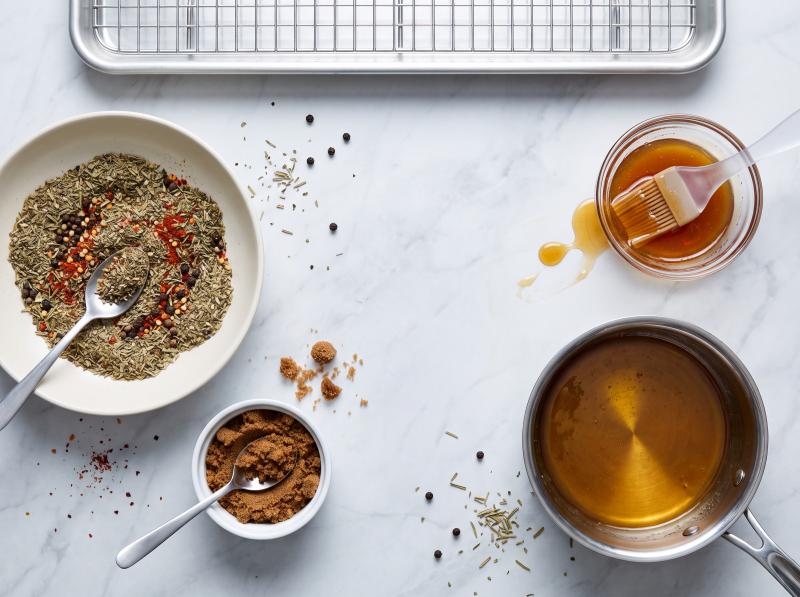
If you want the sweetness, put it in a glaze and brush it on in the last 30 minutes, where it can caramelize without burning. Keep it out of the rub that sits on the bird for three days.

The timing, which matters more than the blend
-
Three days out, or at minimum 24 hours: Pat the turkey dry. Rub the salt and baking powder mixture over the whole surface and inside the cavity, working some under the skin of the breast where you can loosen it with your fingers.
-
Set it on a rack over a rimmed sheet pan and refrigerate it uncovered. Uncovered is not optional. Air circulation is what dries the skin, and dry skin is what crisps.
-
The morning you roast: Apply the herb rub, again working some under the breast skin, along with softened butter or oil if you use it. The herbs go on late because 72 hours of refrigeration does dried herbs no favors.
-
Do not rinse the bird. Rinsing undoes the dry brine and sprays raw poultry juice around your sink.
-
Roast as usual, and taste the gravy before you salt it. A dry-brined bird gives up seasoned drippings, and gravy is where over-salting usually shows up.
Smaller birds and bone-in breasts do well on 24 to 48 hours. Anything over 10 pounds benefits from the full three days, because the salt needs time to travel inward.
How long the rub keeps
The herb blend keeps for two to four years, technically. Technically is doing a lot of work in that sentence.
Dried herbs fade faster than ground spices, and sage and thyme are among the quickest to go quiet. The blend is at its best within six months. Past a year it still smells like something, but it will not season a 14-pound bird with any authority.
Keep it somewhere cool, dark, and dry. Not the cabinet directly above the stove, which is where nearly everyone keeps spices and is the worst possible place for them. Heat and light are what kill them.
The salt and baking powder mixture is a different story. Baking powder loses its lift over time, though that hardly matters here since you are using it for pH rather than leavening. Mix that portion fresh anyway. It takes ten seconds.
What else to use it on
The herb rub is not a once-a-year blend, which is the argument for making more than you need:
-
Roast chicken, about 2 teaspoons for a 4-pound bird, salted separately
-
Bone-in pork loin or pork chops
-
Roasted potatoes, tossed with olive oil and salt
-
Winter squash, carrots, and parsnips
-
Stuffing or dressing, about 1 tablespoon per pan, in place of poultry seasoning
-
Sausage, mixed into ground pork at about 2 teaspoons per pound
-
Compound butter for bread or for finishing a steak
-
White bean or chicken soup, a teaspoon stirred in early


Questions that came up
Can I mix the salt into the rub anyway? You can, and plenty of recipes do. You lose the ability to scale to the bird and you have to apply everything at once, which means the herbs sit on the turkey for three days. It works. It is just measurably less good on both counts.
What if my turkey is kosher, self-basting, or came in a brine? Then it is already salted, and a full dry brine will push it too far. Check the label for a salt solution. Cut the salt to a quarter of the amount above, or skip bowl one entirely and use only the herb rub.
Can I use table salt? Not by the same measurement. Table salt is much denser and finer, so an equal volume is far saltier. Weigh it, and use about 60 percent of the volume you would use of coarse kosher salt.
Is the baking powder necessary? No, and the bird will still be good without it. It is a small assist toward browner, crisper skin, not a structural ingredient. Do not substitute baking soda, which will taste metallic.
Fresh herbs instead of dried? For the late rub, yes, using roughly three times the volume. Not for anything that sits for days, where fresh herbs turn dark and slick against wet skin.
Do I need to whisk it, or can I shake it? Shake it in the jar, and shake it well. Garlic powder clumps and dried sage is fluffy enough to float, so you want it thoroughly combined rather than layered.
How much rub per pound? Roughly 1/2 to 3/4 teaspoon of the herb blend per pound of bird, which is where the 1/3 cup figure comes from. Under the skin counts double, so go lighter there than you think.
Can I make this ahead as a gift? The herb rub, yes, and it is a good one. Give it as the saltless blend with the per-pound salt instructions on the tag, rather than premixing salt in for someone whose turkey you have never seen.