What "Medium Oven" Actually Means
A translation guide for anyone holding a recipe card that assumes you already know.

My grandmother's cards do not tell you what temperature to use. Neither do her mother's. They say moderate oven, or hot oven, or in one case just "bake." One card tells me to cook something until it is done, which is technically correct and completely useless.
This is the page I built for myself while typing up the box. If you have inherited cards, a church cookbook, or a recipe clipped out of a newspaper in 1954, you need it too.
Why they wrote it that way
They were not being vague. They were trying to be accurate.
Most home ovens had no thermostat. You had a wood or coal stove, a firebox, and your own judgment, so a number on a card would have been meaningless. What you needed was a description of heat, and everyone cooking knew what those descriptions meant, the way you know what "medium high" means on your stovetop right now.
There were tests, and they are genuinely charming.
You could hold your hand inside the oven and count. Sixty seconds before it got uncomfortable meant a slow oven. Forty-five meant moderate. Thirty-five meant hot.
You could sprinkle a teaspoon of flour on a tin plate and watch it. Light brown in five and a half minutes, slow oven. Three and a half minutes, moderate. A minute and a half, hot.
Or you could use a sheet of white paper on the oven floor. A 1915 home economics textbook put it precisely: paper slightly browned after five minutes was right for sponge cakes, and delicately browned after two minutes was right for layer cakes with fat in them.
Somebody's grandmother stood in a kitchen with a piece of paper and a pocket watch, and then wrote "moderate oven" on a card, assuming you would do the same.


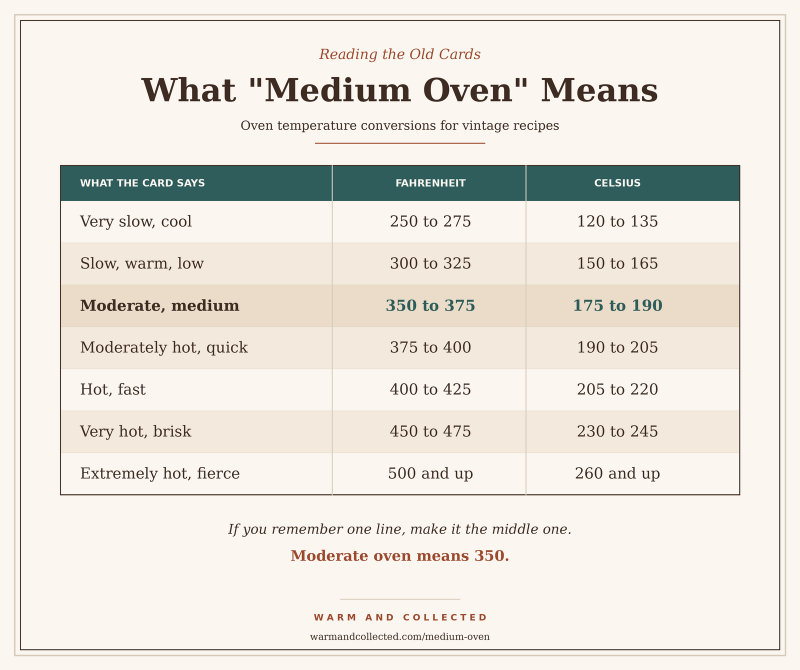
If you remember one line, make it this one. Moderate oven means 350, which is where most of us were going to set it anyway.
The measurements nobody explains
Butter comes in a size ladder, smallest to largest: a pat, a walnut, a knob, an egg.
-
A pat of butter: about a teaspoon
-
Butter the size of a walnut: one to two tablespoons, roughly an ounce
-
Knob of butter: two tablespoons. A dollop: about a tablespoon and a quarter, so slightly less"
-
A dollop: about a tablespoon and a quarter, so smaller than a knob, not larger
-
Butter the size of an egg: a quarter cup, four tablespoons, about two ounces
-
A gill, pronounced "jill": half a cup, near enough. A US gill is four ounces, an Imperial gill is five
-
A teacup: a scant three quarters of a cup. The actual china ran anywhere from four to six ounces
-
A coffee cup, a tumbler, a glassful: one cup
-
A wineglass: a quarter cup
-
A saucer: one heaping cup
-
A scant cup: one cup minus two tablespoons
-
A jigger: an ounce and a half, and yes, that one I knew already
One more that explains a lot of old cards. When a recipe says a measure of sugar and a like amount of butter, it means use the same vessel for both, whatever it happens to be. The proportions were the recipe. The cup was just the tool she had.

Where the sources disagree, and they do
Most modern references put butter the size of an egg at two ounces. A conversion table printed in 1895 says one thing. A conversion table ten years later, may say something different. And at least one collector of period sources argues the nineteenth-century range ran anywhere from four to eight ounces, depending on when and where the card was written.
The period range may run anywhere from two to eight ounces, which is not a rounding error.
I am not going to pretend there is one answer. The egg was smaller, the butter was different, and the woman writing it down was working from her own hand, not a standard.
So here is what I do. I transcribe the card exactly as it was written, then put my conversion in a note underneath, and I say which one I used. If it comes out wrong, at least the original survived my guess. That rule holds everywhere on this site: the card is the record, my translation is just my opinion.
Three practical things
-
Buy an oven thermometer. Yours is probably lying to you, and anything more than ten to fifteen degrees off is worth knowing about before you commit a pound of butter to it.
-
Give the oven longer than the beep. Ten to fifteen minutes past the preheat signal is when the temperature actually settles.
-
And when an old card says to bake until done, believe it. She was telling you to use your eyes, because she knew her oven and could not describe it to you. You know yours. That part has not changed.
Take it with you
Free printable version of both charts, sized to stick inside a cupboard door. No signup.
If you would rather have the whole system, the hosting playbooks do the same job for a holiday dinner: how much to buy, when to start the thaw, and what time everything goes in.
