A little history
This recipe ran in the Houston Chronicle on November 20, 1941. That was Thanksgiving Day for most of the country. It was the last year of Roosevelt's "Franksgiving." Starting in 1939, he'd moved Thanksgiving a week earlier than the traditional last Thursday of November, partly to give stores a longer Christmas shopping season. Not every state went along with it. For three years the country split, with some states celebrating one Thursday and others the next. Texas didn't fully go along with the change, and in 1939 it celebrated both. So while this recipe ran on Thanksgiving Day in much of the country, some Houston cooks may still have been planning their menus for the following week.
Seventeen days later, on December 7, 1941, Pearl Harbor was attacked. Whoever baked these rolls that November was cooking for the last Thanksgiving before the United States went to war. Roosevelt had already admitted that spring that the experiment hadn't worked. Two days after the attack, the Senate voted to fix Thanksgiving on the fourth Thursday of November, and Roosevelt signed it into law the day after Christmas. It's been the fourth Thursday ever since.
The original recipe
Pumpkin Rolls (Two Dozen)
-
½ package fast granular yeast
-
¼ cup lukewarm water
-
¼ teaspoon sugar
-
½ cup scalded milk
-
1½ teaspoons salt
-
¼ cup sugar
-
About 4 cups sifted bread flour
-
1 cup cooked or canned pumpkin
-
1 egg, well beaten
-
4 tablespoons melted shortening
Pour the granular yeast into the lukewarm water, add the quarter teaspoon sugar, stir and let stand about five minutes. Pour the scalded milk into mixing bowl, stir in the salt and the quarter cup sugar and let cool. When milk is lukewarm add the softened yeast and 1½ cups of the sifted flour. Beat smooth. Add the finely mashed (or sieved) pumpkin, the beaten egg and the melted (not hot) shortening. Add remaining flour, or as much as required to knead into a smooth, but soft, dough.
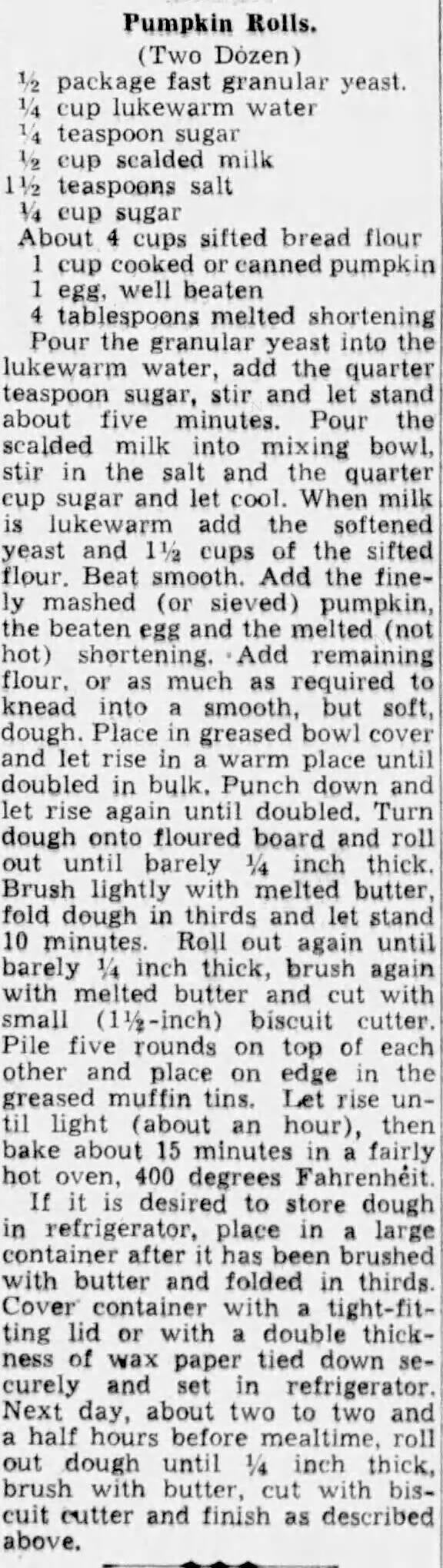
Place in greased bowl cover and let rise in a warm place until doubled in bulk. Punch down and let rise again until doubled. Turn dough onto floured board and roll out until barely ¼ inch thick. Brush lightly with melted butter, fold dough in thirds and let stand 10 minutes. Roll out again until barely ¼ inch thick, brush again with melted butter and cut with small (1½-inch) biscuit cutter. Pile five rounds on top of each other and place on edge in the greased muffin tins. Let rise until light (about an hour), then bake about 15 minutes in a fairly hot oven, 400 degrees Fahrenheit.
If it is desired to store dough in refrigerator, place in a large container after it has been brushed with butter and folded in thirds. Cover container with a tight-fitting lid or with a double thickness of wax paper tied down securely and set in refrigerator. Next day, about two to two and a half hours before mealtime, roll out dough until ¼ inch thick, brush with butter, cut with biscuit cutter and finish as described above.

What to use today
Makes 24 rolls
-
1¼ teaspoons active dry or instant yeast (about half of a ¼-ounce packet)
-
¼ cup warm water (105–110°F)
-
¼ teaspoon sugar, plus ¼ cup sugar
-
½ cup whole milk
-
1½ teaspoons salt
-
About 4 cups bread flour
-
1 cup canned pumpkin purée (not pumpkin pie filling)
-
1 large egg, beaten
-
4 tablespoons shortening or unsalted butter, melted and cooled
-
About 4 tablespoons melted butter, for brushing
Method
-
Stir the yeast and ¼ teaspoon sugar into the warm water. Let it sit about 5 minutes, until foamy.
-
Warm the milk until it's steaming, then stir in the salt and ¼ cup sugar. Let it cool to lukewarm.
-
Add the yeast mixture and 1½ cups of the flour to the milk. Beat until smooth.
-
Beat in the pumpkin, egg, and melted shortening.
-
Add the rest of the flour a little at a time, just until you have a soft, smooth dough. Knead about 5 minutes.
-
Put the dough in a greased bowl, cover it, and let it rise in a warm place until doubled, about 1 to 1½ hours.
-
Punch it down and let it rise again until doubled, about 45 minutes to an hour.
-
Roll the dough out on a floured counter until it's just under ¼ inch thick. Brush it with melted butter, fold it in thirds like a letter, and let it rest 10 minutes.
-
Roll it out again to just under ¼ inch, brush with butter, and cut out rounds with a 1½-inch biscuit cutter.
-
Stack five rounds together and stand each stack on its edge in a greased muffin cup. You'll need two 12-cup muffin tins.
-
Cover and let rise until puffy, about 1 hour. Heat the oven to 400°F.
-
Bake about 15 minutes, until golden brown.
To make ahead: after step 8, put the folded dough in a covered container and refrigerate it overnight. The next day, 2 to 2½ hours before dinner, roll it out and pick up at step 9.
A few things worth knowing
"Fast granular yeast" is just dry yeast. In 1941 it was new. Most home bakers were still using fresh cake yeast. Active dry or instant yeast both work here.
You don't need to scald the milk. Old recipes scalded milk because of the milk they had back then. With today's pasteurized milk, warming it is plenty.
Use canned pumpkin purée. The recipe calls for "cooked or canned pumpkin." Canned purée works best. Pumpkin pie filling already has sugar and spices in it.
The stacks bake up like fan-tans. Standing five buttered rounds on edge in each muffin cup makes layered rolls that pull apart. Don't pack them tight; they need room to rise.
Keep the dough soft. Pumpkin adds moisture, so the amount of flour can vary. Stop adding flour once the dough is smooth and only a little tacky.
Good with
Turkey, gravy, and a little extra butter. The make-ahead option is handy on Thanksgiving: do the rolling and folding the day before, and the dough waits in the fridge until you need it.
Sources:
"Pumpkin Rolls," The Houston Chronicle, Houston, Texas, Thursday, November 20, 1941, page 35. Clipping via Newspapers.com.
Franklin D. Roosevelt, Proclamation 2522, Thanksgiving Day, 1941. The American Presidency Project: https://www.presidency.ucsb.edu/documents/proclamation-2522-thanksgiving-day-1941
National Archives, "Thanksgiving: Another FDR Experiment," Prologue magazine, Fall 1990: https://www.archives.gov/publications/prologue/fdr-thanksgiving-experiment
"Franksgiving," Wikipedia: https://en.wikipedia.org/wiki/Franksgiving
