
A little history
This recipe comes from a February 21, 1980, article in The Salt Lake Tribune titled “Make Lovely Yorkshire Pudding for Family.” Food editor Donna Lou Morgan had joined seven sisters from Bradford, England, for one of their regular gatherings in Salt Lake City.
The sisters called themselves the “Yorkshire lassies.” They swam together, painted, sewed, made rugs, shared lunches and regularly gathered around the English food they had grown up eating.
Their hostess, Frances Maud, served roast beef, potatoes and individual Yorkshire puddings covered with beef gravy. She remembered walking home from church as a child and smelling roast beef and Yorkshire pudding cooking for Sunday dinner. In winter, her family usually served it with roast beef and potatoes; in spring, it accompanied roast lamb.
Her father had taught all seven daughters to make Yorkshire pudding. Although he was blind, Mrs. Maud remembered him preparing the family’s Sunday dinner while the girls attended Sunday school.
This story caught my attention for a personal reason. Some of my own ancestors left Bradford for America in the 1850s. I cannot say that they made Yorkshire pudding in exactly the same way, but this recipe comes from the same place they once called home.
I also never miss a proper Sunday roast when I am in England, especially when Yorkshire pudding is involved. Between the Bradford connection and my love of Sunday roast, this article felt like one I had to save.
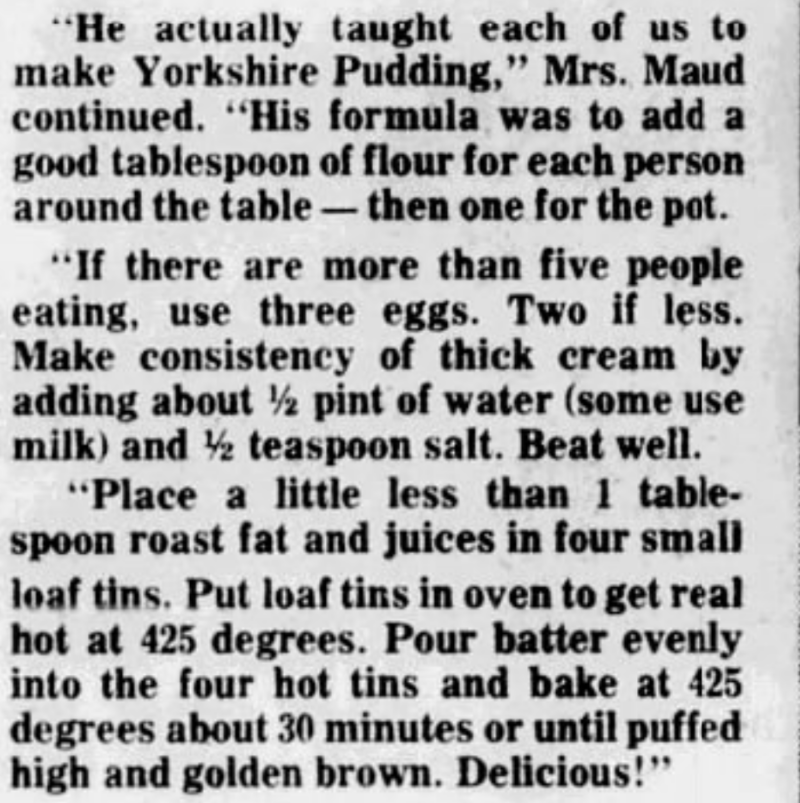
The original family method
Frances Maud explained that her father measured the flour according to the number of people at the table. He used one generous tablespoon of flour for each person, followed by one extra tablespoon “for the pot.”
For more than five people, he used three eggs. For fewer people, he used two.
He added about half a pint of water, although Mrs. Maud noted that some people preferred milk. The batter was judged by consistency rather than by a rigid measurement: it needed to be as thick as cream. He added ½ teaspoon salt and beat the batter well.
A little less than 1 tablespoon of roast fat and juices went into each of four small loaf tins. The tins were heated in a 425°F oven until very hot. The batter was then divided among them and baked at 425°F for about 30 minutes, or until the puddings were tall and golden brown.
The article does not provide a fixed amount of flour because Mrs. Maud’s father measured it according to the number of diners.

The second recipe
The same article included a more conventional measured recipe from Ann Chamberlin Setzer. She identified it as her English-born mother’s recipe.
Yorkshire Pudding
-
1 cup flour
-
1 cup milk
-
1 teaspoon salt
-
2 eggs, well beaten
-
Meat drippings or fat
Sift the flour and salt together.
Mix the milk and eggs and beat them well. Add the egg mixture to the dry ingredients and beat with a rotary beater until smooth.
Let the batter stand for 30 minutes.
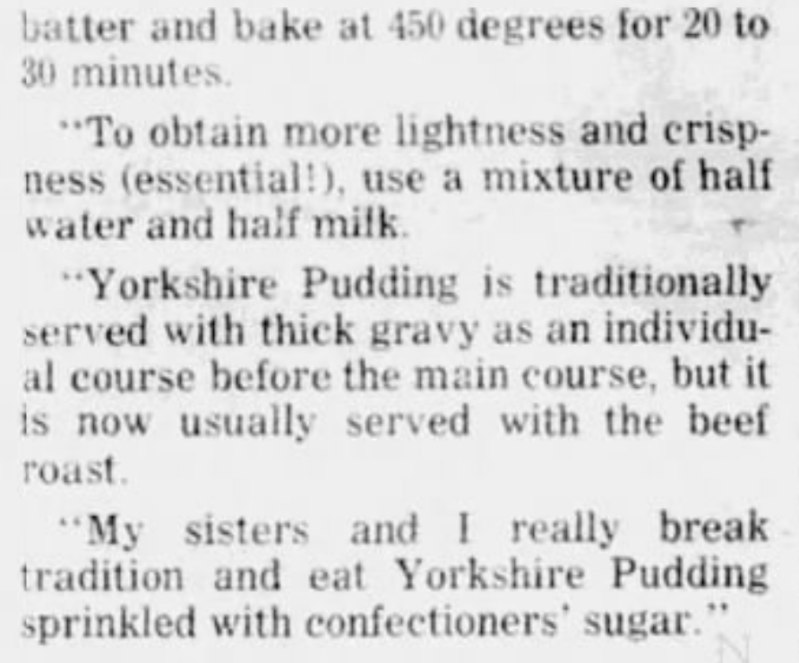
Heat the oven to 450°F. Melt the drippings or fat in muffin tins. Pour in the batter and bake at 450°F for 20 to 30 minutes.
The article also suggests using half milk and half water for lighter, crisper puddings.
What to use today
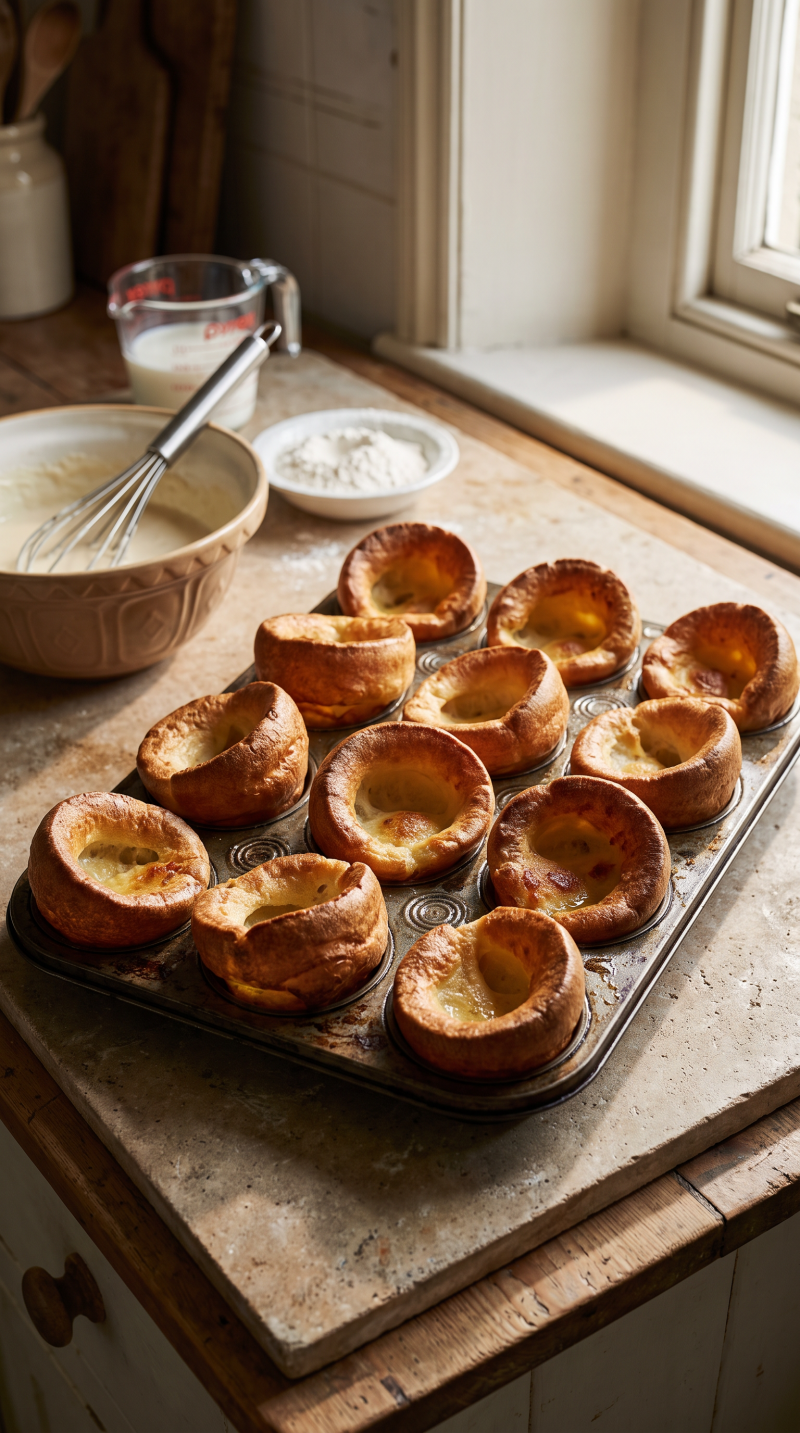
Makes 12 individual Yorkshire puddings
-
1 cup all-purpose flour
-
1 teaspoon fine salt
-
2 large eggs
-
½ cup whole milk
-
½ cup water
-
About 2 tablespoons beef drippings, beef tallow or neutral cooking oil
Method
-
Whisk the flour and salt together in a mixing bowl.
-
In a separate bowl or large measuring cup, whisk the eggs, milk and water until evenly combined.
-
Gradually pour the liquid into the flour, whisking until the batter is smooth.
-
Let the batter rest at room temperature for 30 minutes.
-
While the batter rests, heat the oven to 450°F.
-
Divide the beef drippings among the cups of a standard 12-cup muffin tin. Use enough to coat the bottom of each cup.
-
Put the muffin tin in the oven for about 5 minutes, until the fat and the tin are very hot.
-
Carefully remove the tin from the oven. Working quickly, divide the batter evenly among the muffin cups. Fill each cup no more than halfway.
-
Return the tin to the oven immediately.
-
Bake for 20 to 25 minutes, until the puddings have risen dramatically and are deep golden brown.
-
Do not open the oven door during the first 20 minutes. A rush of cooler air may cause the puddings to collapse before their structure has set.
-
Serve them immediately while the edges are crisp and the centers are still warm.
This modern method follows the complete measured recipe printed in the article rather than attempting to supply the missing fixed flour quantity in Frances Maud’s family formula.


A few things worth knowing
Hot fat is essential
The batter should sizzle when it reaches the pan. Heating the tin and fat first helps the puddings rise quickly and develops their crisp, browned edges.
Beef drippings provide the most traditional flavor, especially when Yorkshire pudding accompanies roast beef. Beef tallow is a practical alternative. A neutral high-heat cooking oil will also work, although it will not contribute the same savory flavor.
Resting the batter helps
Ann Chamberlin Setzer’s recipe tells the cook to let the batter stand for 30 minutes. The rest gives the flour time to absorb the liquid and allows the batter to become more evenly hydrated.
Milk or water?
Frances Maud’s family used water, although she acknowledged that some cooks preferred milk. The second recipe uses milk but recommends a combination of half milk and half water for extra lightness and crispness.
The modern version follows that suggestion. Milk contributes flavor and browning, while water keeps the batter from becoming too rich or heavy.
Her father measured for the table
Mrs. Maud’s father did not begin with a fixed cup of flour. He counted one generous tablespoon for every person at the meal and added one more for the pot.
That kind of instruction belongs to a kitchen where the cook knew the batter by sight. The important measurement was its final consistency, which Mrs. Maud compared to thick cream.
Mrs. Maud used loaf tins
Instead of a single roasting pan or a modern muffin tin, Mrs. Maud’s family divided the batter among four small loaf tins. Each tin received roast fat and juices before it was heated in the oven.
That would have produced individual puddings larger than those made in an ordinary muffin tin.
Keep the oven closed
The article includes a bit of family kitchen wisdom: if you open the oven, “they’ll eat your Yorkshire pudding.”
The playful warning has a practical purpose. Yorkshire pudding rises from steam and needs intense, steady heat. Opening the door too soon can cause the puddings to sink.
The batter does the lifting
There is no baking powder, baking soda or yeast in Yorkshire pudding. The eggs, moisture and very hot oven create its dramatic rise.
As the thin batter heats, steam expands inside it. The eggs and flour set around the expanding air and steam, creating the familiar puffed shape and hollow center.
It was once served first
The article explains that Yorkshire pudding was traditionally served with thick gravy as a separate course before the meat. Serving the filling pudding first allowed the roast to stretch farther around the table.
By 1980, the article noted that it was more commonly served alongside the roast beef, as it usually is today.
The sisters sometimes ate it sweet
The sisters occasionally broke with tradition and sprinkled their Yorkshire pudding with confectioners’ sugar. That may sound unusual if you only know it as part of a savory roast dinner, but the plain batter can work with either sweet or savory accompaniments.
Serve it right away
Yorkshire puddings are at their best when they have just come out of the oven. They naturally settle as they cool, and the crisp exterior begins to soften.
Have the rest of the meal ready before they finish baking so they can go directly from the oven to the table.
Good with
Serve Yorkshire pudding with roast beef, crisp roasted potatoes, vegetables, and plenty of rich gravy.
It also belongs beside roast lamb, just as Frances Maud remembered from springtime meals in Bradford. Horseradish sauce goes well with the beef, while mint sauce is a natural choice with lamb.
If you want to follow the sisters’ less traditional example, save one pudding for dessert and dust it lightly with confectioners’ sugar.
Sources
“Make Lovely Yorkshire Pudding for Family,” by Donna Lou Morgan, The Salt Lake Tribune, Salt Lake City, Utah, February 21, 1980, page 43.
